
For Veterans
Blogs
Why the Caluza Triangle Matters for Your VA Disability Claim
If you’re filing for VA disability benefits, there’s one concept every veteran should understand before submitting a claim:
The Caluza Triangle
It may sound like legal jargon, but in reality, it’s one of the simplest ways to understand why some VA claims get approved—and why others get denied.
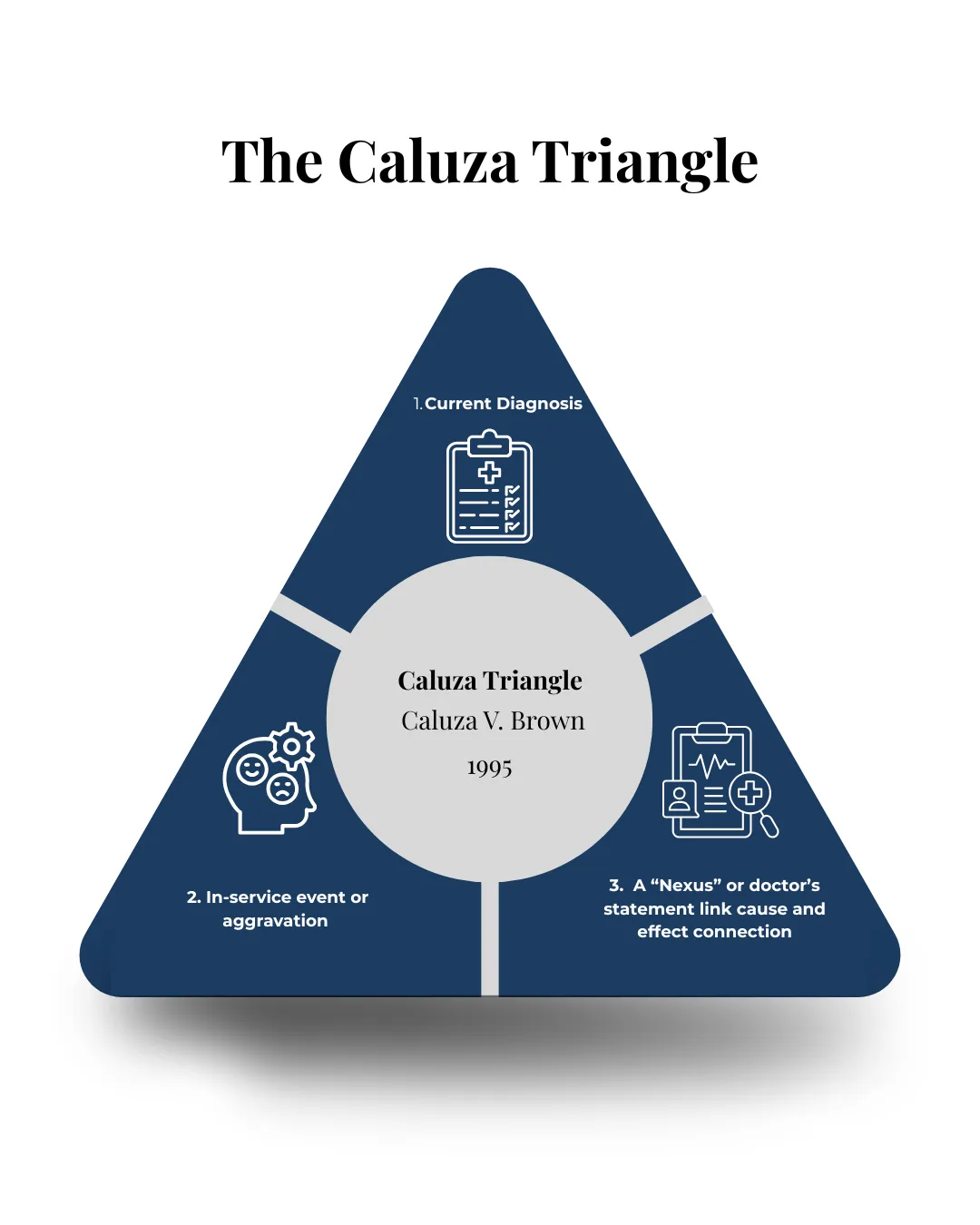
At its core, the Caluza Triangle refers to the three essential elements needed to establish service connection for most VA disability claims:
A current diagnosed disability
An in-service event, injury, illness, or aggravation
A nexus (medical link) connecting the current disability to service
VA’s own evidence guidance for original disability claims requires these same three components: evidence of a current disability, evidence of an in-service event/injury/disease, and evidence of a link between the two. This framework is also reflected in VA’s Fully Developed Claim checklist and 5103 notice guidance.
For many veterans, understanding this triangle is the difference between filing with confidence and filing a claim that’s missing a critical piece.
What Is the Caluza Triangle?
The “Caluza Triangle” is a popular way to explain the legal framework that came out of Caluza v. Brown, a veterans law case often cited in discussions about service connection. In practical terms, it means that most direct service connection claims need three things: a present disability, something that happened during service, and evidence linking the two. This same three-part structure is echoed in VA’s own claim evidence instructions and by VA News, which describes a successful compensation claim like a “three-legged stool”—remove one leg, and the claim falls apart.
Think of it this way:
If one side of the triangle is weak—or missing entirely—your claim becomes vulnerable to:
denial
deferral
a weak C&P opinion
unnecessary delays
an underrated decision
That’s why this concept matters so much.
The 3 Parts of the Caluza Triangle
1. Current Diagnosis (You Must Have a Current Disability)
The first part of the triangle is simple:
You need evidence that you currently have the condition you’re claiming.
For an original or new disability claim, VA requires medical evidence of a current physical or mental disability. In some cases, lay evidence can help describe symptoms, but a medical diagnosis is often the strongest foundation—especially for complex conditions. VA’s evidence pages consistently emphasize that a claim starts with proof of a current disability.
Common examples of evidence:
VA treatment records
Private medical records
Specialist evaluations
Diagnostic imaging (MRI, X-ray, CT, sleep study, etc.)
Mental health evaluations
DBQs (when applicable)
Common mistake:
A veteran files based only on old service records but has no current diagnosis or no recent treatment documentation.
Why this hurts your claim:
Even if you were treated in service, VA still wants evidence that the condition exists now.
2. In-Service Event, Injury, Disease, or Aggravation
The second part of the triangle is proof that something happened during military service that caused, triggered, or worsened the condition.
Under 38 C.F.R. § 3.303, service connection generally means the evidence must show that a disease or injury resulting in disability was incurred in service or, if it preexisted service, was aggravated by service. The regulation also says VA must consider service records, medical records, and relevant lay evidence in light of the “places, types and circumstances” of service.
This can include:
Service Treatment Records (STRs)
Line of duty reports
Deployment records
Personnel records
Incident reports
MOS-related exposures
Combat records
Lay statements / buddy statements
Evidence of worsening of a pre-service condition
VA also explains that claims can be based on:
in-service disabilities
pre-service conditions made worse by service (aggravation)
post-service disabilities linked to service
special circumstances such as presumptive or secondary pathways
Important note:
Not every condition has to be diagnosed in service.
Under 38 C.F.R. § 3.303(d), service connection can still be granted for a condition diagnosed after discharge if the evidence shows it was incurred in service.
That means veterans should not automatically assume:
“If it wasn’t diagnosed while I was in, I can’t win.”
That belief is often false.
3. Nexus (The Link Between #1 and #2)
This is the part that often makes or breaks a claim.
A nexus is the medical connection between your current condition and your military service.
VA’s evidence requirements repeatedly state that, for an original claim, you need evidence of a link between your current disability and the in-service event, injury, or disease. VA notes that medical records or medical opinions are usually needed to support this connection.
A nexus can come from:
A favorable C&P examiner opinion
A private medical opinion
A nexus letter
Strong treating physician notes
Certain presumptive rules (where VA presumes the connection by law)
VA News specifically explains that unless the connection is obvious from the record, the nexus often comes from the VA-scheduled C&P exam or a medical opinion. For presumptive conditions, VA may establish the nexus by law if the service requirements and diagnosis are met.
Common mistake:
Veterans assume:
“My diagnosis is enough.”
“My STRs are enough.”
“The VA will figure out the connection.”
Sometimes they will.
But many times, the claim gets denied because the file never clearly connected the dots.
Why the Caluza Triangle Is So Important
The Caluza Triangle matters because it helps you understand how the VA evaluates service connection before you submit a claim.
Instead of filing based on hope, emotion, or incomplete records, you can ask:
Do I have a current diagnosis?
Do I have evidence of an in-service event, illness, injury, or aggravation?
Do I have a nexus that clearly links them?
That simple framework mirrors VA’s own claim evidence requirements for original claims and gives veterans a practical checklist before filing.
If you’re missing one side of the triangle, you may face:
a denial for lack of diagnosis
a denial for lack of in-service evidence
a denial for lack of nexus
a weak or unfavorable C&P opinion
a need for a Supplemental Claim later
If VA has already denied your claim, a Supplemental Claim may allow you to submit new and relevant evidence that could fix the missing piece. VA explains that new evidence is something not previously considered, and relevant evidence is something that proves or disproves an issue in your claim.
How the Caluza Triangle Applies to Different Types of VA Claims
While the Caluza Triangle is most often discussed with direct service connection, the logic still helps in other claim types too.
1. Direct Service Connection
This is the classic version:
current diagnosis
in-service event
nexus
This is the exact evidence structure VA lists for original and new disability claims.
2. Secondary Service Connection
For a secondary claim, the structure shifts slightly.
Instead of proving an in-service event for the new condition, VA says you need evidence showing:
you have a new physical or mental condition, and
there’s a link between that new condition and a disability VA has already service connected
Example:
Service-connected lumbar spine condition
New diagnosis of radiculopathy
Medical evidence showing the back condition caused or aggravated the radiculopathy
In other words, the “triangle” still exists—but the second side is now your already service-connected condition.
3. Presumptive Service Connection
Presumptive claims can feel easier because VA may presume the connection under certain rules.
VA’s guidance explains that for some presumptive conditions, the link to service may be established without the veteran separately proving it the usual way—as long as the qualifying service criteria and diagnosis are met.
In many presumptive cases:
You still need a current diagnosis
You still need proof of qualifying service/exposure
The nexus may be presumed by law
This is why presumptive claims can be powerful—but only if the veteran correctly documents the service criteria.
4. Increased Rating Claims
If you’re already service connected and filing for an increase, the Caluza Triangle is not the main issue anymore.
VA says increased claims mainly require current medical evidence showing the disability has worsened. Lay evidence can help too.
That means the battle shifts from:
“Is it service connected?”
to:
“How severe is it now?”
How to Strengthen Every Side of the Caluza Triangle
1. Strengthen the Diagnosis
Before filing:
Get updated treatment records
Make sure the diagnosis is clearly documented
Don’t rely only on symptoms without medical confirmation (when a diagnosis is needed)
If applicable, obtain specialist evaluations
Ask yourself:
Is the diagnosis current?
Is it clearly named in the records?
Is the severity documented?
2. Strengthen the In-Service Evidence
Gather:
STRs
Personnel records
Deployment history
MOS exposure evidence
Incident reports
Buddy statements
Personal lay statements (VA Form 21-10210 can be used for lay evidence)
VA specifically recognizes lay evidence and buddy statements as valid forms of evidence in disability claims.
Ask yourself:
What exactly happened in service?
Can I show when it started—or worsened?
If records are thin, who can corroborate it?
3. Strengthen the Nexus
This is often where veterans need the most help.
Possible evidence includes:
a strong C&P exam
The treating provider notes that connects the condition
a private medical opinion
a formal nexus letter
evidence showing continuity of symptoms over time
Even though a nexus letter is not always required, consistent treatment records and symptom history can strengthen the connection between service and the current disability. VA’s evidence framework and veteran-law guidance consistently emphasize that medical evidence and continuity matter.
Ask yourself:
Has any doctor clearly connected this condition to service?
If not, what evidence could help bridge that gap?
Am I relying on assumption instead of proof?
What If Your Claim Was Already Denied?
If your claim was denied because one part of the triangle was missing, that doesn’t always mean the claim is over.
You may need:
a current diagnosis that wasn’t in the file before
a new nexus opinion
new and relevant evidence for a Supplemental Claim
stronger lay statements
proof of presumptive eligibility
better medical records showing continuity or worsening
VA’s Supplemental Claim process is specifically designed for situations where you need to add new and relevant evidence after a prior decision.
This is critical:
A denial often doesn’t mean:
“You don’t qualify.”
It often means:
“The evidence didn’t satisfy one side of the triangle.”
That’s a very different problem—and often a fixable one.
The Caluza Triangle matters because it gives you a simple, powerful framework for understanding service connection.
Before you file, ask yourself:
✅ Do I have a current diagnosis?
✅ Can I show the in-service event, illness, injury, or aggravation?
✅ Do I have a nexus connecting the two?
If the answer is “not sure” on any one of those, your claim may need more work before submission.
Bottom line:
Most VA disability claims are won or lost based on the evidence—not just the condition.
And in many cases, the evidence problem is really just a Caluza Triangle problem.

Transparency Matters
Victory Veteran Protection is a private, veteran-owned business and is not affiliated with the U.S. Department of Veterans Affairs (VA). We are not a Veterans Service Organization (VSO), accredited representative, attorney, or authorized VA claims agent.
We provide claim preparation education, coaching support, and educational consulting, but veterans remain responsible for preparing and submitting their own VA disability claims.
Free assistance may be available through VA-accredited representatives and organizations such as the American Legion, DAV, VFW, state veteran affairs offices, and other accredited professionals. Choosing to work with Victory Veteran Protection is entirely voluntary.
Any examples, statistics, or results referenced on this website are based on general experiences and do not guarantee outcomes. Every VA claim is unique, and results will vary.
The information provided on this website is for educational purposes only and should not be considered legal or medical advice.


© 2026 Victory Veteran Protection, LLC